

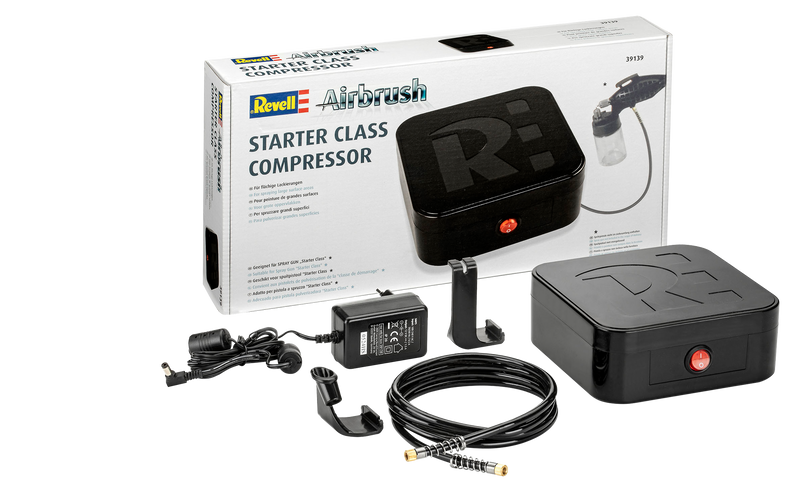

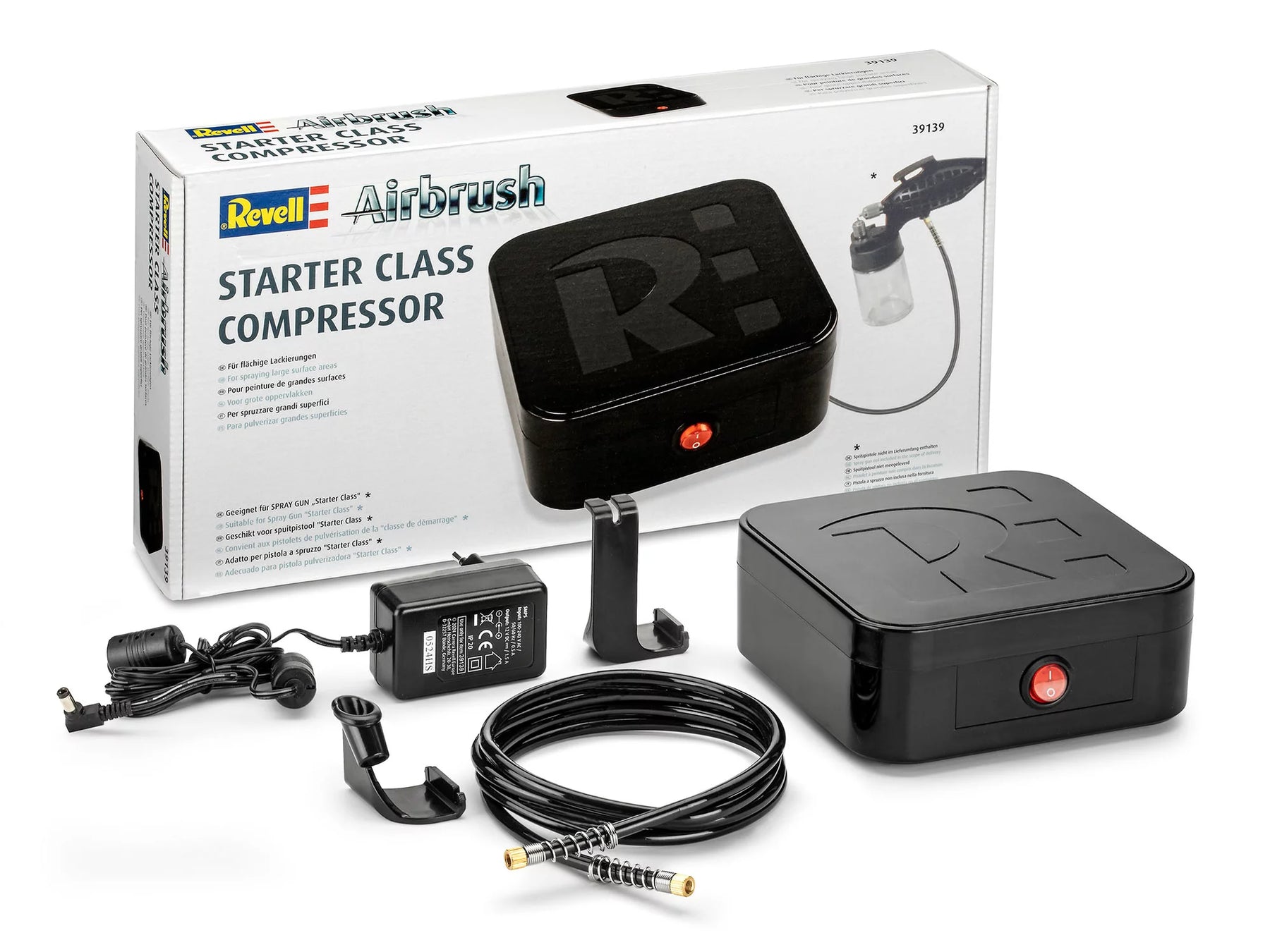


The heart of your workplace: Why the right compressor is crucial
If you've ever been annoyed by uneven paint splashes, clogged nozzles or rough paint surfaces, the cause probably wasn't due to your hand control. In the vast majority of cases, an unstable air supply is the real culprit. A high-quality compressor provides you with a consistent working pressure that you can adjust exactly to the viscosity of your paints and the diameter of your nozzle. While conventional compressed gas cans noticeably lose pressure after a few seconds and freeze due to evaporation, an electric compressed air system keeps the preset value absolutely stable - from the first to the last drop of paint.
In our daily model building practice, we often experience that many beginners initially want to save money on the compressed air source. But this is exactly where you are making false savings. A reliable unit enables you to achieve reproducible results. Whether you are emphasizing delicate panel lines on a jet, applying a ship's hull primer to large areas or depicting photorealistic aging effects such as rust and soot: a cleanly adjustable air flow gives you full control over the spray jet. This makes your work process plannable, relaxed and leads to results that you can be proud of.
Diaphragm or piston compressor: understand the technology in detail
When looking for the ideal device, you will come across two different designs: diaphragm and piston compressors. Both systems have specific advantages that depend on your ambitions and usage habits.
Diaphragm compressors for simple work
Diaphragm compressors generate compressed air through a vibrating membrane made of rubber or plastic. Since no mechanical components rub directly against each other in this design, these models run oil-free and require little attention when it comes to lubrication. They are relatively light, handy and often sufficient for occasional use or smaller jobs with coarser nozzles. However, membrane devices usually only reach a moderate maximum pressure of around 2 to 3 bar and have a slight pulsation in the air flow during continuous operation if no additional buffer is available.
Oil-free piston compressors as a modern standard
Oil-free piston compressors have become the undisputed standard for committed plastic model making. Here, a small piston, usually equipped with wear-resistant Teflon seals, compresses the sucked-in air in the cylinder. This design works extremely efficiently, effortlessly builds up working pressures of up to 4 to 6 bar and impresses with its impressive delivery performance at moderate speed. Since even modern piston devices operate completely without oil lubrication, there is never any risk of microscopic oil mist particles getting into the air hose and ruining your sensitive acrylic paints.
With or without air tank? The advantages of an integrated pressure vessel
One of the most important fundamental decisions when purchasing concerns the compressed air tank. In principle, you can achieve clean results with both variants, but the ease of use differs significantly.
A tankless compressor turns on as soon as you activate the device or pull the trigger on your gun and runs continuously throughout the spraying process. This is absolutely functional for simple work, but it causes the engine to constantly generate heat. In addition, in inexpensive entry-level models, a minimal pulsation of the piston stroke can be transferred to the spray pattern, which is annoying when making ultra-fine freehand lines.
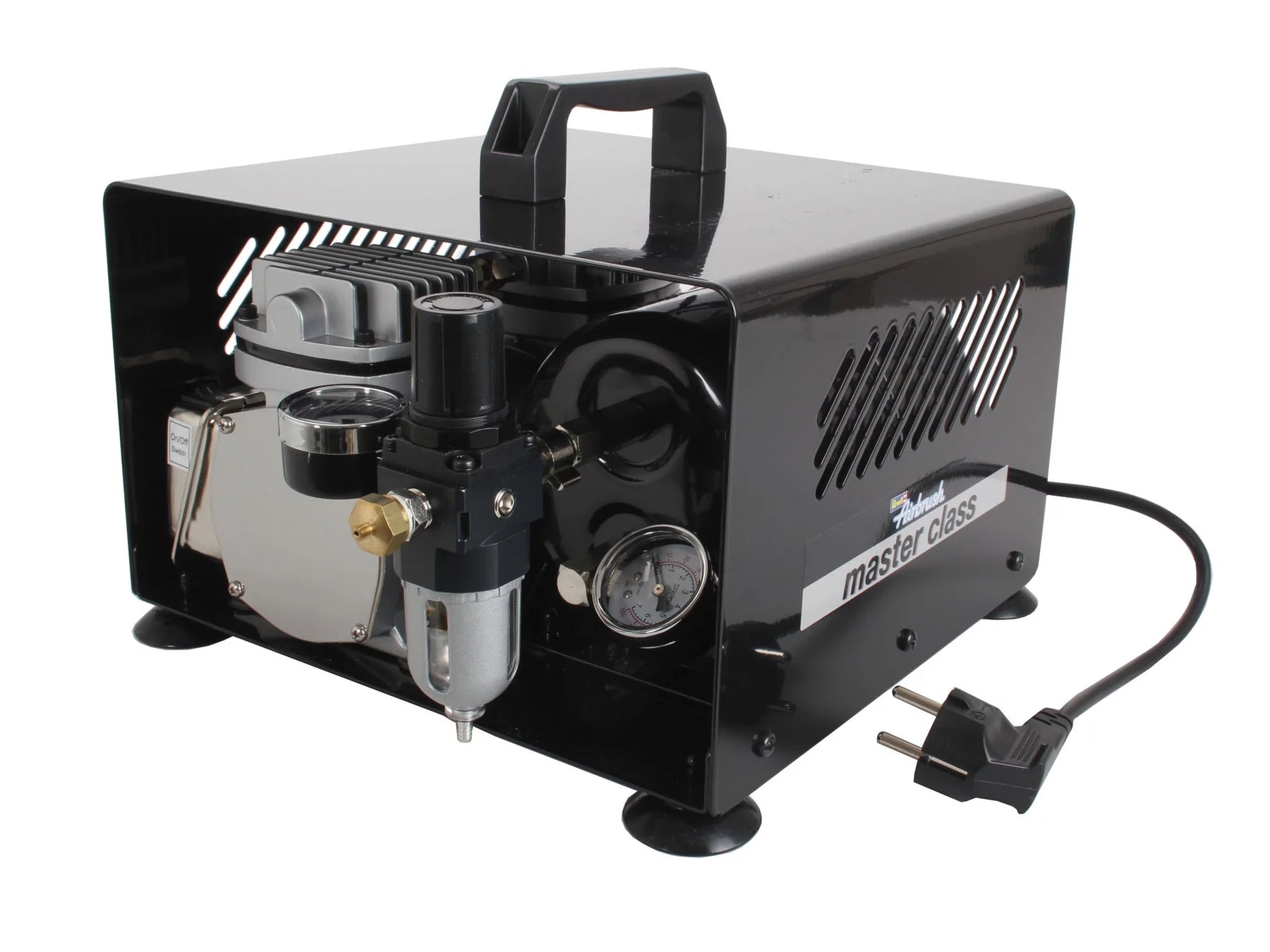
Models with an integrated storage tank – typically with a capacity of between one and three liters – solve this problem elegantly:
- Absolutely pulsation-free airflow: The tank serves as a buffer that completely eliminates pressure fluctuations from piston movement. A perfectly linear air flow arrives at your spray gun.
- Engine protection thanks to automatic switch-off: The unit fills the tank up to the predefined switch-off pressure (often around 4 bar) and switches off the electric motor completely. You paint silently from the air stored in the boiler. Only when the internal pressure falls below a certain threshold (e.g. 3 bar) does the engine automatically start again for a short time.
- Lower heat generation: Due to the intermittent operation, the entire system remains significantly cooler, which multiplies the service life of the seals.
- Less condensation: The compressed air has time to cool down in the tank. As a result, the air moisture condenses on the inner wall of the boiler and does not even migrate into the hose.
Pressure reducers, pressure gauges and water separators: the indispensable triad
A good compressor is not only characterized by its engine block, but above all by its control and filter fittings. If you work with different color types in model making, three components are absolutely essential:
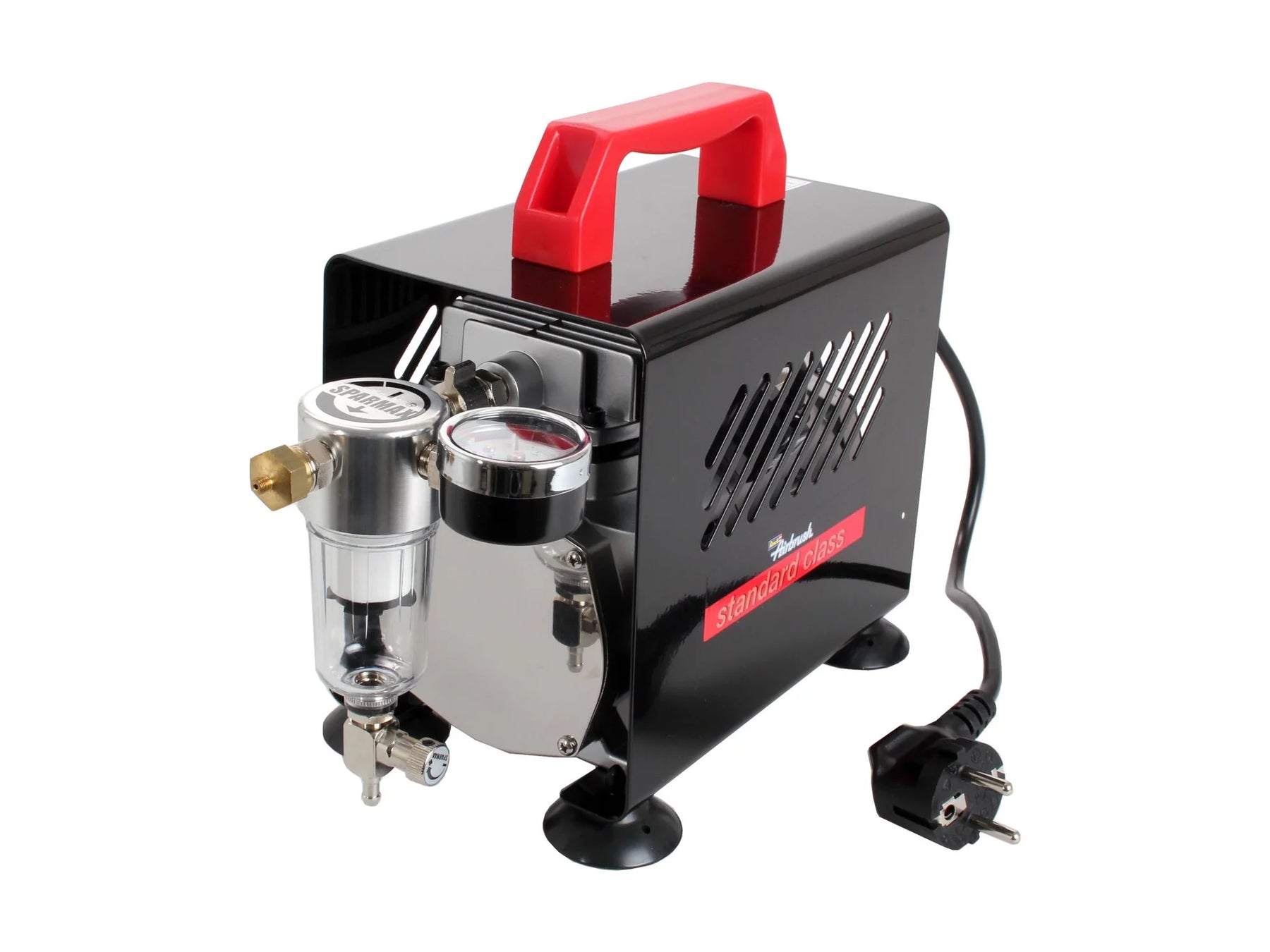
The infinitely adjustable Pressure reducer allows you to set the actual operating pressure exactly to a fraction of a bar. While thicker primers or fillers often require 1.8 to 2.2 bar, highly diluted detail paints or glazes require pressures of just 0.8 to 1.2 bar. The preceding Pressure gauge shows you this value clearly on a scale - so you can write down your settings exactly for later construction phases and repeat them at any time.
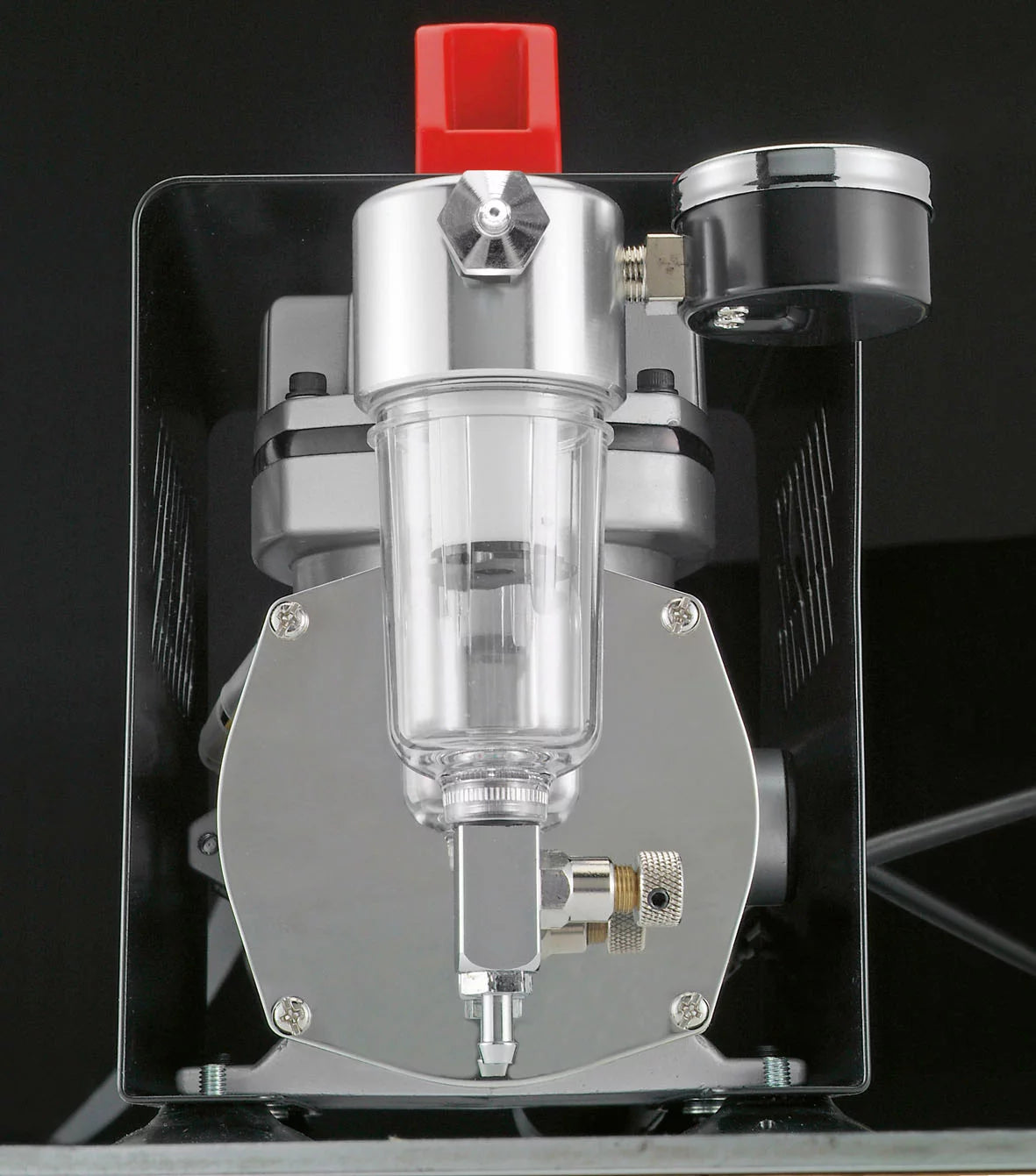
A high-quality one is at least as important Water separator. When ambient air is compressed, its temperature rises while the relative humidity increases. If the air in the hose cools down again, condensation forms. Without a water separator, this moisture would be shot drop by drop through the nozzle. The result would be unsightly craters and stains on your freshly painted model. The filter catches these droplets in a transparent collecting bell, which you can empty in no time using a simple valve on the bottom.
Whisper-quiet operation: model building in the living area without noise stress
Many model makers do not have a separate workshop in the basement, but instead paint at their desk in the study, living room or bedroom. Under such conditions, the noise level becomes the decisive criterion. Old hardware store compressors easily reach 85 to 95 decibels - a level that requires hearing protection and is inevitable for arguments with roommates or neighbors.
Modern model building compressors are designed as real whisper devices. With a sound pressure level of usually just 40 to 48 dB(A), they are no louder than a modern household refrigerator or a quiet conversation. Rubberized feet effectively decouple the motor from the surface and prevent vibrations from being transmitted across the table or floor as booming structure-borne noise. This means you can work on your projects undisturbed late in the evening or on the weekend while someone is sleeping or reading in the next room.
The perfect interaction: connections and matching spray guns
Your compressor only develops its full potential when combined with the right tool. Most quality models have a standardized 1/8-inch hose connection (G 1/8"), which is considered the de facto industry standard in the model making sector. You can easily connect the unit to your guns using flexible fabric hoses or spiral tubes. Anyone who regularly changes between different nozzle sets benefits from practical quick-release couplings, which enable reconnections without tools and without loss of pressure.
Depending on the project requirements, you use different systems: For the most delicate shading, camouflage and tiny cockpit details, high-quality ones are recommended Airbrush spray guns with fine needle geometry. If you are looking for a robust tool for even primers, large areas of body paint or clear coat sealants, a proven all-rounder like the Airbrush Body Standard Class 39101 an excellent choice. Its precisely manufactured nozzle head harmonizes perfectly with the typical delivery rates of modern piston compressors.
If you want to further optimize your working environment, it's also worth taking a look at something functional Airbrush accessories such as sturdy gun holders with table clamps, washout containers for low-odor intermediate cleaning and special hose distributor pieces for the simultaneous operation of several spray pens.
Practical tips for optimal printing results
To achieve first-class results from the first minute, you should never look at work pressure in isolation. It is always in a direct triangular relationship to two other variables: the paint viscosity and the nozzle diameter.
- Always adjust pressure with the trigger pulled: A common beginner's mistake is reading the pressure on the pressure gauge while the gun is closed (back pressure). Always adjust the working pressure so that you press the trigger on your gun down so that air continuously escapes (flow pressure). This flow pressure is the real value at which your paint is atomized.
- Adjust the viscosity: If your paint is mixed too thickly, the spray jet will tend to form drops (“speckling”) at low pressure. Instead of simply increasing the pressure massively - which often leads to color drift and messy edges - it is better to gradually dilute the color with the appropriate thinner until it reaches the consistency of low-fat milk.
- To be on the safe side, inject test samples: Before you get to your finished model, always make a few test marks on a piece of plastic sheet, cardboard or an old kit part. This means you can check within seconds whether the set pressure is optimal for the current color mixture.
Complete systems for a smooth start
Especially if you are new to the fascinating hobby of spray painting, the abundance of technical terms, thread sizes and system components can seem challenging. In this case we offer pre-configured ones Airbrush complete sets an uncomplicated overall solution. In these systems, the compressor performance, hose adapter, pressure reducer and spray gun are precisely matched to one another at the factory. You save yourself a long search for suitable transition pieces and can concentrate directly on assembling and coloring your kits.
Maintenance and care: This is how your compressed air system stays fit for years
Although modern oil-free piston compressors are extremely durable and essentially low-maintenance, they reward you with a minimum of attention with decades of reliability. Just follow these simple care steps:
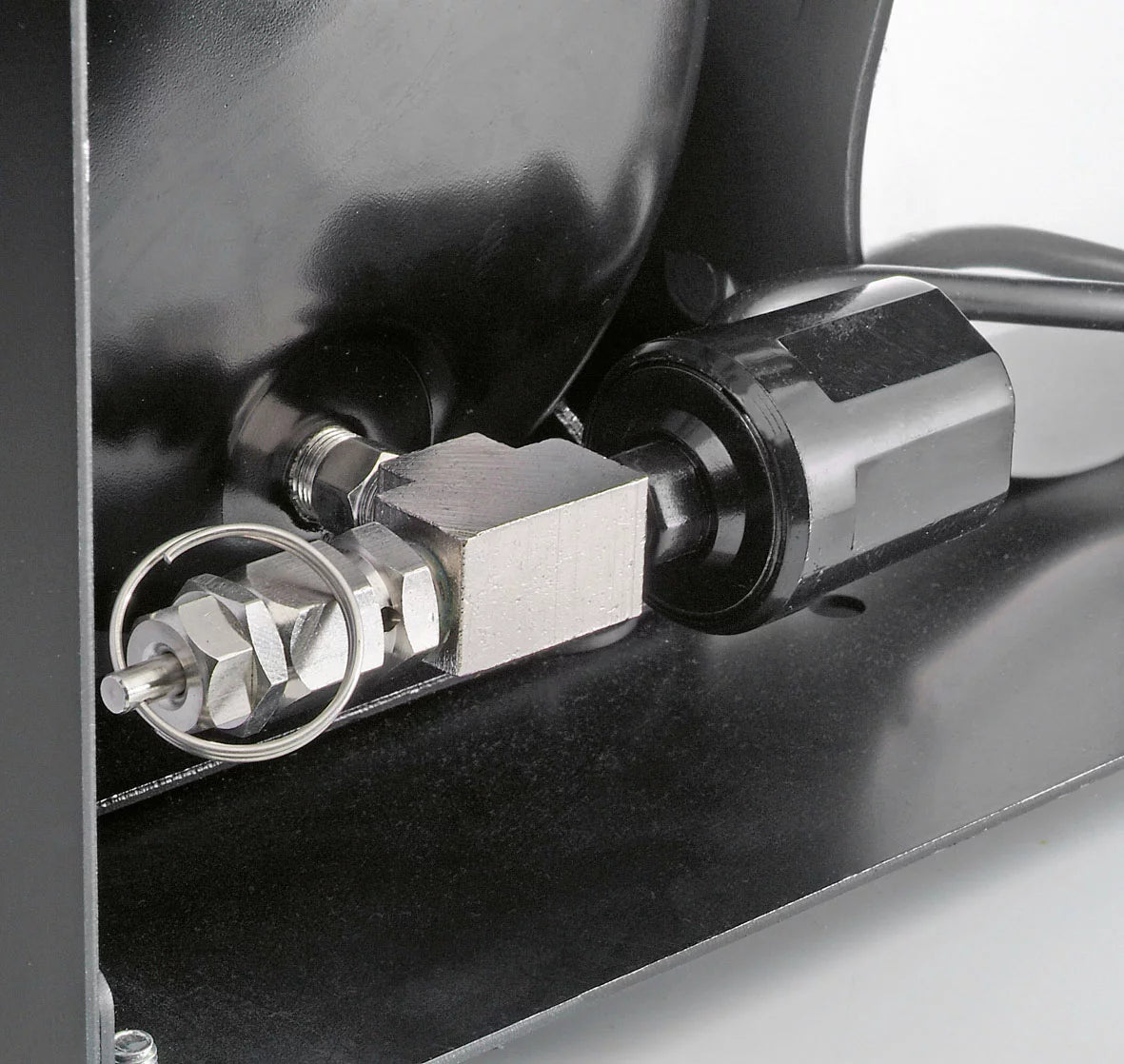
After each long day of painting, drain the water separator and – if available – the compressed air tank. There is a small knurled screw (drain valve) at the bottom of pressure vessels. When the boiler is unpressurized or slightly pressurized, turn it on carefully so that any accumulated condensation can escape completely. This reliably prevents corrosion inside the tank. Also check the compressor intake filter occasionally. In model making workshops, fine grinding dust tends to accumulate in the surrounding area. Simply remove impurities from the foam intake filter every few months with a little compressed air or lukewarm soapy water so that the cylinder can always breathe freely.