

Why the right compressed air is the foundation of every perfect paint job
If you strive for absolutely flawless surfaces in plastic model making or customizing, you know: Even the finest pigmented paint and the highest quality spray gun are of little use if the air supply fluctuates. An unsteady air flow inevitably leads to unsightly paint splashes, orange peel or uneven layer thicknesses. In the airbrush sector, compressed air is much more than just transport air - it is the control element that determines the quality of atomization, spray pattern and edge sharpness.
A constant, pulsation-free airflow allows you to get the fine dosage you need for shading, weathering or tiny camouflage patterns on a scale of 1:72 and 1:35. Modern compressed air systems offer you full control over the working pressure, usually in the range between 1.0 and 2.5 bar. Our practice shows time and again: If you rely on clean compressed air regulation right from the start, you save yourself frustration when painting and the tedious reworking of botched parts.
The heart of your workplace: understanding compressed air generation
Model builders have two main options for providing compressed air: compressed gas cans for occasional use or fully equipped compressors for regular and demanding work. While propellant cans may seem practical for first steps, they cool down quickly when sprayed for a long time, leading to a rapid drop in pressure and messy color results.
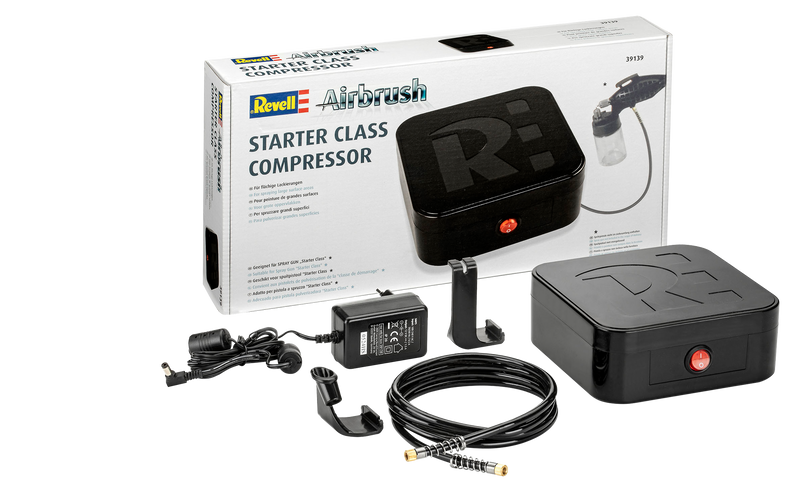
There is no alternative to ours for reliable and reproducible results powerful airbrush compressors over. Piston compressors with an integrated air tank are considered the gold standard on the workbench: the tank stores the compressed air, meaning the engine does not have to run constantly. This not only protects the mechanics and reduces background noise, but also guarantees a completely vibration- and pulsation-free air flow directly at the nozzle tip.
Water separators and pressure reducers: your life insurance against splashes
When ambient air is compressed, condensation is created for physical reasons. If this moisture gets into the air hose unnoticed, it shoots drop by drop through the nozzle in the middle of the painting process and destroys your fresh paint application. An upstream water separator reliably filters out this condensate before it can cause damage.
In combination with a precise pressure gauge and pressure reducer, you always have the exact pressure in view. While large-area primers often require a pressure of around 2.0 bar, fine lines with heavily diluted paints work best at around 1.2 to 1.5 bar. By delicately turning the control valve, you can adjust your compressed air precisely to the respective project.
Hoses, adapters and couplings: Reliable connections for maximum flexibility
One aspect that is often underestimated when putting together equipment is the connection technology. The best compressor loses its effectiveness if porous hoses or leaky threads cause pressure losses. With our well thought out practical airbrush accessories you ensure absolute tightness and ergonomic comfort in the workplace.
- Fabric-coated textile hoses: They offer maximum kink resistance while maintaining high flexibility. In contrast to rigid plastic spirals, they do not prevent you from making delicate hand movements.
- Quick couplings (Quick Release): You can separate your gun from the hose in one move without having to switch off the compressor or laboriously unscrew threads. The integrated check valve prevents any air from escaping.
- Custom-fit adapter pieces: They easily bridge different thread dimensions such as 1/8 inch, 1/4 inch or manufacturer-specific connections so that every part of your system fits together perfectly.
- Air distributor with multiple connections: Ideal if you want to operate several spray guns for primer, base paint and clear coat in parallel without having to constantly switch them over.
Compressed air and spray technology in perfect harmony
The optimal coordination between compressed air and color consistency is a craft that quickly becomes second nature with the right tools. Our selection of precise airbrush spray guns requires a precisely balanced amount of air in order to generate the finest droplet sizes without overspray.
A proven tool for ambitious model builders, for example, is the Airbrush Body Standard Class 39101. In this system, a precisely manufactured air guide ensures that the Venturi principle in the mixing head develops its full effect. If the working pressure on the compressor is precisely balanced, the air flow sucks in the paint evenly and atomizes it into a velvety mist. Visible brush strokes are finally a thing of the past.
Typical error patterns caused by incorrect working pressure
If the spray pattern does not meet your expectations, the cause is often the relationship between viscosity and air pressure. Pay attention to the following signals:
- Spider legs (spidering): The color runs outwards in a star shape. The cause is usually too high a working pressure with paint that is too thin or too close a distance to the model. Reduce the pressure by 0.3 to 0.5 bar.
- Coarse-grained drop formation (spitting): The paint is not finely atomized, but rather splashes onto the plastic in thick dots. Here the pressure is too low to break up the pigments cleanly, or the paint is simply too thick. Increase the air pressure gradually.
- Dry Spray: The paint arrives on the model already dry and forms a rough, floury surface. The cause is often too high pressure in conjunction with warm air flow or too great a spray distance.
Maintenance and longevity: This means your compressed air system remains ready for use for years
Compressed air components are robust tools, but regular care rewards them with decades of reliability. The most important routine after each painting day: completely drain the condensation collected in the tank or water separator via the drain valve. Moisture inside the tank can lead to corrosion over time, while standing water in the filter reduces its separation performance.
Also check the sealing rings on couplings and hose screw connections regularly. Even minimal leaks mean that compressors have to be recharged more frequently, which leads to unnecessary heating and increased wear. A drop of silicone-free sealant or sealing tape on screw threads ensures that no millibar of pressure escapes unused. This means your workplace remains quiet, efficient and always ready for your next model building highlight.


