

The Artemis program marks a new, fascinating era of human spaceflight, and you can now bring this piece of history directly to your crafting table at home. When you look up at the starry sky at night, you might dream of the massive machines that will take humanity back to the moon and soon to Mars. It is precisely this fascination that the detailed model kit of the latest heavy-duty rocket captures perfectly. In this article you will learn everything about the real technology behind the gigantic support system, how the individual components work together and why building this model takes your craftsmanship to the next level. Join me on a detailed journey from the launch pad to lunar orbit.
What is the NASA Artemis Space Launch System (SLS)?
The NASA Artemis Space Launch System (SLS) is the most powerful heavy-lift rocket in modern space history, designed specifically for manned deep space missions to the Moon and Mars. With an impressive total height of 98 meters in the Block 1 configuration, this system towers over almost all previous launch vehicles. Upon launch, the rocket produces a massive 39.1 meganewtons of thrust, enough to carry a payload of over 27 tons directly into lunar orbit. The development of this architecture combines proven components from the space shuttle era with the most modern aerospace manufacturing technologies. What this means for you is that you are looking at the absolute backbone of future space exploration. The design is modular, meaning the rocket can be upgraded for future missions with even larger upper stages to carry even heavier cargo into the deep solar system.
How does the SLS rocket propulsion work?
The SLS rocket's propulsion system consists of a massive central core stage with four liquid-fueled RS-25 engines and two side-mounted solid boosters. These two white boosters on the sides provide more than 75 percent of the total takeoff thrust in the first 2 minutes of the flight. The orange core stage, which has a gigantic diameter of 8.4 meters, holds over 2.7 million liters of liquid hydrogen and liquid oxygen. The four RS-25 engines at the rear of the core stage burn this fuel extremely efficiently, working for a total of 8 minutes until the rocket reaches Earth orbit. Think of it as a perfectly orchestrated power plant, with every millisecond of fuel delivery monitored by high-performance computers to safely navigate astronauts through Earth's atmosphere.
Why is the Artemis mission important for space travel?
The Artemis program enables humanity's permanent return to the Moon and prepares the technological infrastructure for future manned missions to Mars. In the current year 2026, over 50 years after the last Apollo mission, it is no longer just about a short visit, but about setting up a permanent base station at the lunar south pole. The program aims to test sustainable technologies for resource use in space, such as extracting water from lunar ice. For you as a space enthusiast, this is the most exciting era since the Space Race of the 1960s. The missions include building the Lunar Gateway, a space station in lunar orbit that serves as a stopover for astronauts and equipment before they descend to the lunar surface or venture deeper into the solar system.
Where is the Space Launch System specifically used?
The primary operating location of the Space Launch System is the historic launch complex 39B at the Kennedy Space Center in Florida, from where the rocket begins its approximately 384,400 kilometer journey into lunar orbit. This exact launch pad was already used for the Apollo moon flights and the space shuttle program and was completely modernized for the SLS rocket. After launch, the rocket puts the Orion spacecraft on a precise trajectory that allows the capsule to break away from Earth's gravity. The typical mission duration of an Artemis mission is between 3 and 4 weeks, during which the system is exposed to extreme conditions from the warm, humid air of Florida to the freezing vacuum environment of space.
What does the Revell 1:144 scale model kit offer?
The Revell model kit in a scale of 1:144 is a faithful miniature replica of the real moon rocket, which makes complex space technology tangible for model builders in their home hobby room. If you choose this set, you will receive a model that reaches an impressive height of around 71.2 centimeters when finished. To put this masterpiece on the table yourself, you will find this NASA Artemis Space Launch System (SLS) directly in the official range. The 1:144 scale is the absolute standard for large launch vehicles in the modeling community, which allows you to place this model perfectly next to existing Saturn V or Space Shuttle models in your display case to directly compare the scale of space history.
What details characterize the Artemis model?
Unlike simple toy models, this Revell kit features precisely reproduced surface textures, accurate supply lines and highly detailed engine replicas. With a level of difficulty of level 4, the set is aimed at advanced hobbyists and consists of well over 50 precisely manufactured individual parts. Every groove in the solid boosters and every tile on the heat shield of the Orion capsule was reduced to scale using original NASA CAD data. As you build, you'll notice that even the delicate fuel lines on the outside of the orange core stage are positioned exactly where they are on the original, making this model a true museum piece.
What are the advantages of model building this system?
The systematic assembly of the SLS model enables a deep technical understanding of the complex design and operation of modern launch vehicles. As you invest the average 3 to 5 hours of construction time, you will learn the modular design of the rocket as you assemble the core stage, boosters and payload fairing separately. This process not only promotes your fine motor skills and concentration, but also offers a relaxing break from everyday digital life. The most important benefits for you include:
- Acquisition of sound space technology knowledge through haptic experience.
- Improving fine motor skills when handling delicate components.
- Reduction of stress through focused, manual work.
- Creating an impressive 28-inch-tall exhibit.
What is included with the Revell set?
The scope of delivery of this kit consists of the precisely cast plastic injection moldings, detailed, illustrated construction instructions and authentic water slide images (decals) for correct labeling. The box also contains a structured starting platform, which gives the model a secure and visually appealing stand in your showcase. The construction instructions guide you through the project in logically structured construction phases, starting with the engines and fuselage assembly through to the final placement of the distinctive NASA logos. You receive a complete package that only needs to be supplemented with your own colors and model building glue so that you can start building straight away.
How do you build your NASA model perfectly?
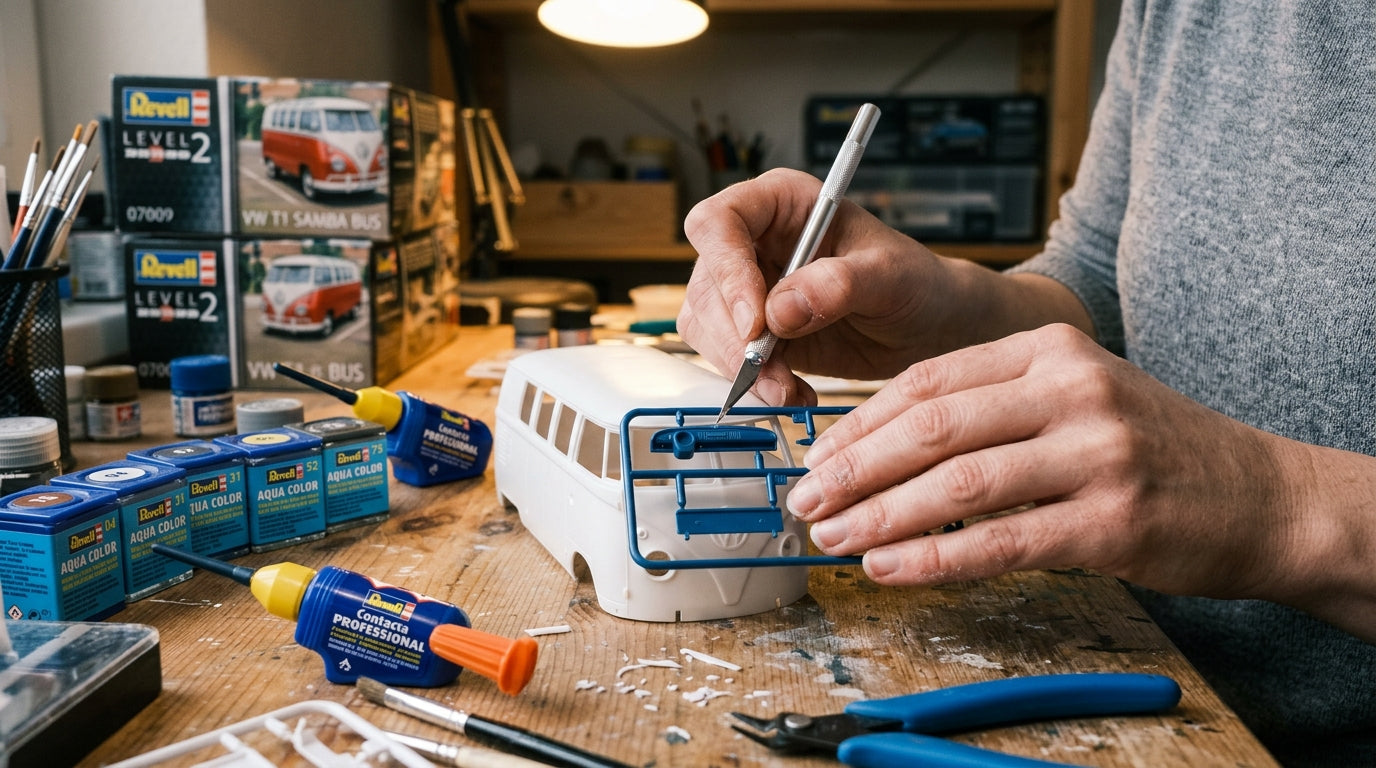
Professional model making preparation consists of washing the casting branches in mild soapy water, preparing special tools and setting up a well-lit, dust-free workplace. By washing, you remove fine release agent residues from production, which means that your colors will later have up to 50 percent better adhesion to the plastic. For assembly you need 3 essential basic tools: a sharp side cutter to cut off the parts, a fine file to smooth the edges and a high-quality plastic glue with a cannula for precise work. If you work at an optimal room temperature of around 20 degrees, the adhesive seams will bond best and prevent unsightly gaps in the large fuselage parts of the rocket.
Which painting techniques ensure realism?
In comparison to classic brush painting, the airbrush technique enables an absolutely even and streak-free application of paint on the large, cylindrical fuselage surfaces of the rocket stages. If you work with a working pressure of around 1.5 bar and apply the paint in 2 to 3 very thin layers, even the finest engravings and rows of rivets on the model will remain visible. In reality, the striking orange core stage of the SLS rocket gets its color from a special insulating foam. To realistically recreate this effect in model making, you can spray the paint from a slightly greater distance so that it dries slightly before it reaches the model - this creates a minimally rough, absolutely authentic surface structure.
Revell Service: Shipping and newsletter benefits
The Revell service offering consists of 24/7 customer support, personal telephone advice and a fast, reliable shipping network for model builders. When you order your model building equipment or new kits, you benefit from free shipping for orders over 50 euros. What this means for you is that purchasing the large SLS model usually already exceeds the threshold for free delivery. If you lose or damage a part while building your model, the support service will help you easily to obtain replacement parts so that your project does not have to remain unfinished.
How do you benefit from the Revell newsletter?
Registering for the official Revell newsletter allows you to receive the latest model building news, exclusive offers and an attractive discount on your next order. As a starting gift, you will immediately receive a voucher for 10 euros, which you can redeem directly when you purchase the Artemis kit or for suitable accessories such as paints and glue. The newsletter also keeps you up to date on new releases in the area of space models. Registration is 100 percent free and can be canceled at any time with just one click, giving you full control over the information that ends up in your inbox.
The Orion capsule: the heart of the manned mission
The Orion spacecraft is the manned transport capsule at the top of the SLS rocket, providing astronauts with state-of-the-art life support systems and navigation devices for deep space missions. This capsule is designed to safely support a crew of up to 4 people in space for an autonomous flight duration of 21 days. This crucial module is also recreated in detail in the model kit, including the Launch Abort System (rescue tower), which would pull the capsule away from the launch vehicle in an emergency. When you mount this small but extremely important component at the top of your model, you complete the silhouette of the world's most powerful rocket.
How is Orion different from the Apollo capsule?
In contrast to the historic Apollo capsule from the 1960s, the modern Orion spacecraft offers significantly more interior space, reusable components and fully digital, redundant flight electronics. The Orion module has 50 percent more volume and offers astronauts approximately 9 cubic meters of usable living space, which is essential for long-duration missions to the moon. In addition, Orion's heat shield is made from state-of-the-art ablative materials that can withstand temperatures of over 2,700 degrees Celsius during re-entry into the Earth's atmosphere. In model construction, this difference is reflected in the changed proportions and the striking, round solar panels of the European service module, which are mounted below the actual crew capsule.
The mobile launch platform in detail
The mobile launch platform included in the model kit is an exact replica of the massive base structure that stabilizes the rocket before and during launch and supplies it with vital systems. This platform guarantees a 100% fit for your model and is equipped with 4 sturdy support masts that support the weight of the rocket. In reality, the entire rocket is assembled on this platform in the Vehicle Assembly Building before it is driven to the launch pad by gigantic crawler transporters. This base is the perfect finish for your diorama at home, as it not only gives the model stability, but also professionally presents it like a real exhibition piece.
Frequently asked questions
What scale is the NASA Artemis SLS model kit?
The kit is on a scale of 1:144. This is an internationally recognized standard scale for large space models. When finished, the model reaches an impressive height of around 71.2 centimeters. This scale allows extremely fine details such as fuel lines and surface structures to be accurately represented, while at the same time the model still fits well in standard collector's display cases.
What difficulty level does this kit have?
This Revell kit is classified as Level 4. This means that it is aimed at advanced model makers who have already gained experience in gluing and painting plastic models. The kit consists of over 50 individual parts, some of which are very delicate. If you take your time and follow the instructions step by step, you will be rewarded with an outstanding and highly detailed result.
Do I need glue and paint for assembly?
Yes, for this kit you need special plastic glue (plastic glue) and model building paints. The components are not simply plugged together, but rather permanently glued to ensure maximum stability. In the enclosed construction instructions you will find an exact list of the Revell color numbers required to faithfully paint the rocket in the correct shades of white, orange and silver.
Is a launch ramp included?
Yes, the kit includes a detailed replica of the mobile launcher. This base structure is essential because it gives the 71.2 centimeter high model a very secure and stable stand. The platform also visually enhances the model and makes it look like a real exhibit straight from the Kennedy Space Center.
How do I redeem the €10 newsletter discount?
To receive the discount, all you have to do is sign up for the free Revell newsletter with your email address. After confirming your registration, you will immediately receive a voucher code by email. You can then simply enter this code in the shopping cart before completing your order for the Artemis kit or accessories. The amount will be deducted directly from the total.
Approximately how long does it take to assemble?
The actual construction time varies depending on your personal experience, but is on average 3 to 5 hours. However, there are also the drying times for the glue and especially for the colors. If you paint the model extensively and attach the authentic water slide decals, you should spread the project over several evenings or a relaxed weekend to achieve the best result.
Conclusion
The construction of the NASA Artemis Space Launch System (SLS) model is a fascinating combination of historical space enthusiasm and precision craftsmanship. With this 1:144 kit you not only bring home a sophisticated craft project, but also create a 71.2 centimeter high monument to modern space exploration. Use the detailed construction instructions, benefit from the newsletter discount and start your own space program right on your desk today.